
Application Overload
There are more apps than anyone could possibly review, so how do you choose? Most people probably hear about new apps from their friends or colleagues, others may read about an app in the news. A few brave souls may go so far as to scour app review sites, and you can too.
Here are a few ways you can find cool apps to impress your friends.
Search Is King
Just like the web, app discovery is overwhelmingly done through search. Most of these searches are done within the App Store or Google Play. Last year Apple acquired app search startup Chomp in order to improve the App Store search results and user experience. The impact of the acquisition was almost immediate.
While the “king of search” is, naturally, Google, another Eric Schmidt-backed company is making significant headway in the world of app search. Quixey is “The search engine for Apps” and you may already be using their search solution without even knowing it. Quixey is a functional search for applications across platforms and is integrated with 3rd Party app distributors, OEMs, and search solutions like Duck Duck Go and Ask.com.
App-Discovery Apps
There are a few of these services, but my absolute favorite is Discovr Apps. If you have ever tried the Visual Thesaurus (if not, you should), it is basically the same concept. When you click on an app, a bunch of related apps pop-up around it. It’s endlessly fun, stream of consciousness search. Discovr is a huge hit with Music, Movies, and now People too.
Of course, this genre could disappear in 2013. Apple has recently “cracked down” on services like Apps Fire and App Gratis (not the same as Discovr, but app-discovery-apps nonetheless).
High-class Reviewers
There are a ton of app review sites, and most of them are paid... meaning app publishers pay to get reviewed by them. However, there are three sites that I find outstanding. They are:
#1 Overlapps
The best of the lot. Overlapps has an inspired, engaging and beautiful design, just a wonderful browsing experience. You can browse apps based on categories (there are many and the icons are brilliant), or see the latest for iPad and iPhone. Another neat feature is you can “love” an app and see which apps are getting the most “love.” Subscribe to Overlapps to add apps you are thinking about buying to your Wishlist or Favorites.
#2 Appolicious
Wow, just an immense database of information about apps. Appolicious is probably the leader in terms of sheer volume of information, and it is very well organized. Recently partnered with Yahoo, the site is filled with Recommendations, News, and Video Reviews -- they own a video review service called AppVee. Also, when you create an account for Appolicious you can “Build your library” of apps.
#3 AppAdvice
AppAdvice features news about Apps. However, there are also some pretty killer mashups of apps they call applists. These applists are based on seasons or holidays, as well as interests, games, etc. Some examples: “life solver” (like health or wedding planning), “empower your device” (apps for productivity, utilities). There are also daily video reviews, and App Guides which are really cool.
App Guides are probably the best review format available. Basically, the best apps for any category have been curated here with subcategories. For example, within Lifestyle you will find “Baby Monitoring Apps” or “Best Goal-Setting Apps.” When you click on any of these sub-categories there are reviews for several apps within that sub-category ranked as “Essential,” “Notable,” Decent,” and “Other Apps.”
 |
| App Advice |
 |
| Overlapps |
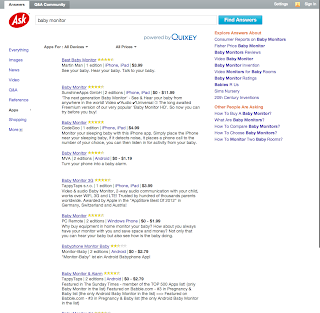 |
| Ask.com App search "powered by Quixey" |
Re-Inventing Your Phonebook
If you’re old enough, you remember having a “little black book” where you kept all your contact information on the go. For real pros, this was a necessary supplement to a rolodex. However, since the 90s “the little black book” has been transforming from an invaluable papermate to perhaps the most vital piece of software we carry. So far in 2013 the phonebook app, or contacts app (whichever you prefer), has been a hit. Here are a few I’ve taken a look at for iOS.
Xobni Pro and Smartr
Xobni provides professionals with a first-class contact management system that can be accessed from Gmail, Android, Outlook, and iPhone. Of course, it will cost you. Last time I checked it was on sale from $10 to $7.99 per month, or $47.95 per year. The pro service offers up some neat tricks for business people who are still (sadly, I am one of them) married to Outlook. My favorite is having access to Gmail, Android, or iPhone contacts from my Outlook... sweet.
For less serious folks you can get Smartr Contacts by Xobni, available for iOS and Android. Like Hacker reported on the app way back in 2011 when it was released for Android, and again in early 2012 when it was released for iOS. Smartr is pretty cool, showing you statistics like how often you appear in messages with your contacts (syncing with iCloud, iCal, Yahoo, Gmail Facebook, Twitter, and if you have a pro account Outlook).
Note: 4 Stars by Macworld, and Lifehacker called Smartr “The best address book for iPhone.”
Addappt
Addappt is new and is now available without an invite code for iOS. It has a more social personality than most contact apps, claiming to be an “up-to-date address book maintained by your friends.”
Of course, up-to-date contacts will probably mean my friends have to be using the app as well. Clearly that represents a problem for Addappt. Last year I worked briefly on an app for Android called Vell, which not only promised to keep contacts up-to-date but also provided personalized video caller-rings. Based on that experience I am certain that critical-mass will be the most important challenge for Addappt, which is probably why they were “invite only” early on.
Thread
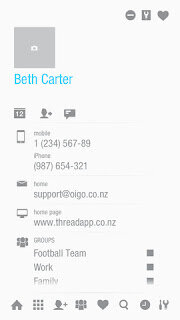
What a beautifully designed app, for those who like the minimalist approach. It is like Any-do for contacts, and I would love to buy it. However, the App Store reviews aren’t plentiful enough to have an average, so you may want to wait for a price-drop promotion (there is probably one on the way).
Thread offers the features you would expect including Facebook and Twitter integration as well as groups. It also offers a dialer, which is cool, but not really a big deal. The big win here is the design, it looks great.
If you think of your iPhone as an extension of your personality (you might as well) and that personality loves design, this app may be just what you are looking for.
CoBook
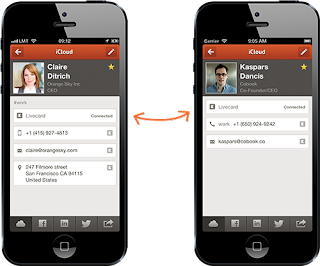
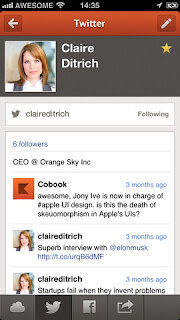
I really like this app, though Smartr is probably better (especially if you go pro). It accomplishes most of what Smartr can do, syncs with the essentials (Facebook, Twitter, Linkedin), and has a nice profile page that let’s you email a “Livecard” to your contacts. Oh yeah, and it “keeps your contacts up-to-date” too, so long as you’re friends on CoBook. Another really cool feature is the ability to tag your contacts, and the dialer is really great as it displays recent contacts’ image above the dial pad (yup, you can click them to rapid dial).
CoBook has done a really good job of making a social utility, offering a nice blend of the social UX with the practical simplicity of a utility. The Verge wrote of Cobook, it is a “revolutionary step forward for contact apps.” I have to agree, it’s pretty awesome.
CoBook Images
Thread Images

Smartr Images


Optimize for Mobile Web
While using landing pages to introduce mobile apps to targeted audiences online has become standard, these pages are not always responsive to various devices. Here are a few reasons why you should have a mobile optimized site, and hopefully make it functional.
4 Billion Mobile Devices and 3 Billion Toothbrushes
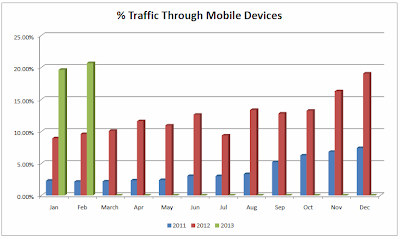
That’s why it is hard to conceive that people would overlook the need to have a mobile web version of their service, or at least of their landing page(s). According to research by Accenture 69% of their respondents accessed the internet using a mobile device, including smartphones and tablets.
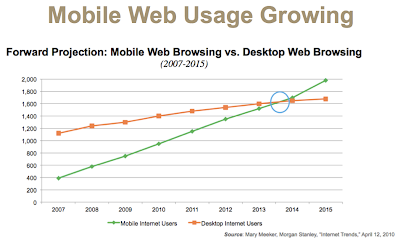
Overall, you can expect mobile internet users to outnumber desktop internet users by next year. Already 25% of Americans access the internet exclusively through a mobile device.
A to the I to the D to the A
Mobile versions of your service can do more than just introduce your service or direct people to download. They can present to potential users the core-benefits of your product by providing a generic version to anyone out there. Not only that, these mobile web versions can be built much faster (and for less money) which means you can start building buzz -- not to mention getting real feedback.
In other words, start building “Awareness” and getting people “Interested” by showing them why your product is better. This will create “Desire” for the product, and means that more people with take “Action” when the time comes. This centuries old model for customer acquisition, AIDA, is the backbone for most acquisition funnels.
Speed and Universal Access
The mobile web is “device agnostic,” meaning it is fairly responsive (changes size to fit a variety of screens) and works on any operating system. Chris Borgan, he co-authored The Impact Equation (NY Times best-seller, blah blah), provided an interesting case study for a sports service that chose to build both native apps and for the mobile web. The service was able to provide core features (up-to-date scores) a full 6 weeks before their native app was ready for review.
Not only were they able to reach their audience sooner, it was available to anyone whether they prefer iOS or Android. That can be an enormous benefit for a bootstrapped team.
How to do it?
First, have a website. Even it is a landing page telling people to sign-up for your beta pre-launch. Next, optimize that site for mobile... it’s not that hard to do, here’s a neat article about it: [LINK].

 |
| A.I.D.A Funnel |
Favorite News - March, 2013
I tweet a lot of news as I ride the subway to and from work every day. It’s a fun way to share what I’m reading and keep a public record of the fact that I do in fact read the news! Taking time to look back at all that’s happened in the past month is a unique kind of meditation, reminding me how interesting life can be.
Yahoo goes Euro
Yahoo is claiming a stake in Europe, wow. While the company announced last year they would close their Seoul office, in 2013 it looks like Yahoo is back in expansion mode. This month has been huge, with the tear-jerking story of a $30M acquisition of a British teen’s news service and serious rumors that Yahoo “wants to buy as much as 75%” of Dailymotion --so, I didn’t know it was French either, but it is. So Ms. Mayer is hoping the pond? Perhaps.
Google sells a premium notebook... PIXEL
First, allow me to say that Samsung’s Chromebook was awesome and I really wanted one. However, that low-ball price of $250.00 makes the Pixel seem outrageously expensive.
That said the Pixel is amazing. Believe me, I’ve used it and it is a beautifully crafted machine. It is a little heavy, but that mass somehow makes it feel worthy of the price. The price comes with some premium hardware too including a Gorillla Glass-cover screen that is (I quote The Verge, but also agree) the “best laptop screen I’ve ever seen.”
Google Pixel is my new favorite notebook and I can’t wait to buy one. One of the best points in The Verge review is how the unique size of the screen is perfect for reading web-pages. Anyone who spend a lot of time reading and working online (yours truly) will notice, so cool they pointed it out.
RIP RSS
Google will kill Reader. This has been a huge deal for so many people, and I totally get that. Though, so much has been written about the downside that the upside was overlooked (at least for a while). Services like Feedly, my next favorite thing after Pulse, have received an enormous boost. That’s great news for developers interested in the space who want to try to build something new. In case you missed them, here is a list of Reader alternatives: LINK.
The drones have arrived
I am a huge believer in drone-tech, but there are some incredible risks associated with its proliferation. This month we saw one of those risks first-hand, and got an early glimpse at how the government will respond. On March 5th, a quadrocopter was spotted “buzzing” a plane on descent at JFK International. Clearly there could have been an accident, and these types of accidents or near-accidents will be increasingly frequent.
Chris Anderson of Wired Magazine wrote a brilliant report a while back on the near reality of a drone-world. As of September, 2013 there may be as many as 50,000 buzzing the friendly skies.
Second-Screens Rule
Business Insider released some incredible data about tablet use while watching TV. Did you know that 85% of tablet owners are using their tablets while watching TV? Holy Smokes! Or so I thought, until I thought about my own TV watching habits (though I rarely watch TV).
As tablet use increases, no doubt overall TV consumption will decrease. But programs or networks that can effectively integrate with tablets will survive in-style. In fact, integrating with “second-screens” may be the only future for TV.


Lessons Learned... R.I.P. Flapon
R.I.P. Flapon... but thanks for the memories.
What now seems like an eternity ago, I graduated from Penn with a MS in Education. I had every intention of getting a second Masters in Korean Language... then entering a global education publisher. I saw the Ed Tech boom coming (it came) and was rearing up to go, planning to spend a few years at Pearson to round-out my skills, then hit the Ed Tech startup scene.
Instead, my wife and I had our first child... the incredible lil' tortuga. My how life can change.
Returning to Korea with every intention of moving on to Hawaii, a friend of mine kept asking me to join his Gangnam startup... "we're gonna be millionaires!" Naturally, I was skeptical. At first I focused on how to get to Hawaii, but it just made more sense to stay. Working with the Founder of a Vancouver-based Ed Tech startup for a few months, my "friend" finally convinced me to join him in his venture.
Truth be told, his over-confidence was a big reason why I eventually joined up. He was my friend, and his burn-rate was ridiculous... he was heading for suicide, figuratively, so I had to help. Anyway, I signed up for a small equity share and the promise of an epic adventure in California... win or lose it would be epic. It was epic.
Flapon actually did pretty well, getting about 80K signups (pretty active too) in just a month. Sure, it wasn't a Pinterest or anything, but we were growing steadily. That was pretty amazing considering everything that was going on internally post launch (epic man, just epic). The twitter account is still up (though inactive) as well as the facebook page.
Sadly, after the "founder" ripped-off everyone (except for maybe one person) including me , a couple of talented developers who worked around the clock, his own cousin, and who knows who else... the "founder" had no idea how to run Flapon and it was taken down. Basically, he'd put in a terrific sum of money (really stupid amount of money) and had not made "the next Facebook." Um, oh well...?
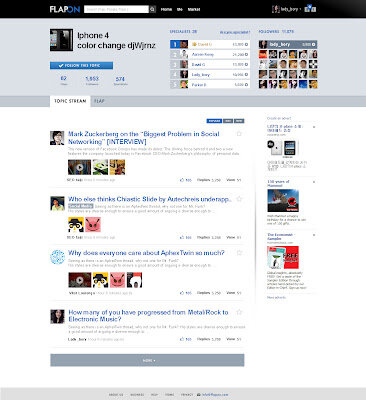
Thanks to Evernote... I still have screenshots! Enjoy ;-)


Wasting Time, Sharing Photos, & Being Happy
People love photo-sharing applications because they provide a false sense of productivity. In reality, they are basically Time-waster applications.
What are time wasters
What is a Time-waster application?
I’d like to attribute this term to Chris Dixon, though I’m not sure if he coined it or not. In the post “Four types of mobile apps” he categorizes mobile applications in four broad strokes:
>Time-wasters
>Core Utilities
>Episodic Utilities
>Notification Driven
Each has a reasonable description, and I encourage you to read the post. I’d like to focus on Time-wasters, which according to Chris Dixon are apps you use while waiting in line -- you could include a lazy Sunday afternoon, or before you go to bed, etc. Often we fill those times with activities we hope are productive like reading a book or magazine, writing in a journal, etc. However, often we fill those times by “wasting” it... watching TV, playing games, using facebook or other social networks, and surfing the web, or using photo-sharing sites like Instagram, WeHeartIt, FFFFound, Tumblr, 500px, Pinterest, etc.
Few people would argue that browsing the web isn’t a go-to time-waster for anyone born circa... well, anyone. Likewise, few would argue that social-networking is not, at least sometimes, also a go-to method for time-killing. Still, other than games, photo-sharing services arguably been the biggest drivers of time-wasting growth in recent years.
Growth of photo-sharing
Writing about the growth of photo-sharing is passe, so bear with me. I’d like to frame it in a slightly different context.
Most readers probably already know the growth of photo sharing has been incredible in 2012. Just how incredible this growth has been can really be exemplified by 3 services: Instagram, Pinterest, and Tumblr. Particularly in the case of Pinterest, the incredibly rapid growth is pretty much common-knowledge. Tumblr’s bright future is less commonly known (only 6% of internet users on on it), unless you are a teen. According to Business Insider, Tumblr is more popular than Facebook among teens... at least for now.
But why!?
So why are these services so popular? Please allow me to digress.
One of the best books ever written about human behavior is, in my humble opinion (not to mention the opinon of The New York Times), “Flow” by Mihaly Csikszentmihalyi... or just, “Mihaly.” At the risk of oversimplifying Mihaly’s seminal work, the basic premise is that we find more happiness by creating meaningful experiences, and the happiest people are those who make each moment meaningful; meaningful experiences can be generated any time we are creating order out of disorder, or gaining knowledge. The flow-state exists when the sum of our meaningful experiences is appropriately matched to a circumstance where we can apply whatever value, knowledge, those particular experiences have provided us. In other words, we are up to a challenge... it is neither too easy, nor too hard.
The most interesting part of this theory, however, is not the definition of the “flow state.” Rather, it’s how people find intrinsic happiness by developing some expertise. And that intrinsic happiness is in the process of developing that skill, as much as in the application of the skill.
Taking this to another level, perhaps more abstract, we could infer that our level of happiness would increase any time we feel we have made a moment valuable. This feeling could exist anytime we are gaining knowledge, or making order out of disorder (structured information equals knowledge, yadda yadda).
So web search... makes me happy. In truth it is often a time-wasting activity, but we can rationalize that activity to be more valuable than doing nothing at all. Mobility has added to our ability to create meaning even more.
However, we are also creatures of evolution, and evolution says we are lazy.
Photo-sharing Makes People Happier
Researching takes time, so making meaning through research in the pre-Google days (dare I say pre-internet) was a challenge that made few people happy. However, as Google endeavoured to make information useful, browsing the web became a grand way to satisfy our need for meaning. Still, it wasn’t something anyone would do.
Enter photo-sharing.
Even babies like it... it is the next level of simplicity in terms of finding meaning (if not, at times, false meaning) in our lives from moment to moment. When people create enormous collections on Pinterest it provides a sense of completion and satisfaction. For many it may indeed be an incredibly useful tool, but for most it is an enabler. Photo-sharing enables more people to create meaningful experience every moment. It’s easy, it’s fast, it’s intuitive, and, of course.... since pictures say a thousand words, it gives us a sense that we are conveying (or consuming) huge amounts of information relatively effortlessly.
Assuming that Mihaly is correct, and the frequency with which we are generating meaningful experiences relates to our happiness, photo-sharing has made happiness that much more plentiful for humanity. Thanks Ben.

The App & Mortar Opportunity
Shopping destinations are crowded with connected consumers. However, retail has yet to perfect a means to harness mobility to direct traffic to retail stores.
What is “App & Mortar”?
By 2010 every destination shopping center was crowded with a new way to drive traffic to their stores, but no-one has been able to do it right. Yet.
At the time, several applications sprung up that tried to address the market including Shopnear.me, Snapette, Shopkick, Fancy, and more. The runaway success of Groupon and LivingSocial (starting a little earlier in 2008) left some important lessons for new ventures in the space. Specifically, retailers were frustrated with cash-flow problems created by newbies who came once and never again, not to mention the potential for erosion of loyalty and brand value.
In 2012 and '13 big retailers are finally taking this opportunity into their own hands. According to Flurry, the “App & Mortar” segment of mobile applications grew by more than 500% in the past year. Flurry’s data indicates much of this growth was driven by the likes of Starbucks, Walmart, and Macy’s, who have all invested significant resources into their own mobile strategy.
Forbes reported that more than 80% of retailers have a presence on mobile (Check out the infographic below by Cognizant). Most of them are offering all the things you’d expect, from shopping and payment to (of course) deals and store location. Retailers who can, do have a mobile presence, and some are doing a great job of executing.
What’s the big opportunity?
Shopping is often about brands, but those brands extend to the destinations. In 2010, my briefly lived startup focused on Santana Row, San Jose, precisely because the location itself is a brand. People travel there to shop, but also to spend an afternoon with family and friends. It’s a social experience as much as anything. These destination cater to a consumer who enjoys spending an afternoon in a well decorated space, where beautiful and unique things surround them, and (of course) can be acquired.
There are hundreds of high-quality individual or regional shops in any given, well-branded, retail destination. This includes a range of retailers from clothing and accessories, to health and beauty services. Are we going to rely on each retailer to have his or her own application? Do the math, that’s a lot applications and no-one wants to spend the energy to keep track of them all.
Big retailers have the advantage, since we all could use a Starbucks app or Westfield Mall app. However, that leaves a huge opportunity for the App & Mortar retail aggregators servicing the destinations and the experience. Connecting people with brick-and-mortar retail through mobile devices will change the way we shop; rather, already has. But the real promise of mobile applications for retail has yet to be fully realized.

What is “App & Mortar”?
By 2010 every destination shopping center was crowded with a new way to drive traffic to their stores, but no-one has been able to do it right. Yet.
At the time, several applications sprung up that tried to address the market including Shopnear.me, Snapette, Shopkick, Fancy, and more. The runaway success of Groupon and LivingSocial (starting a little earlier in 2008) left some important lessons for new ventures in the space. Specifically, retailers were frustrated with cash-flow problems created by newbies who came once and never again, not to mention the potential for erosion of loyalty and brand value.
In 2012 and '13 big retailers are finally taking this opportunity into their own hands. According to Flurry, the “App & Mortar” segment of mobile applications grew by more than 500% in the past year. Flurry’s data indicates much of this growth was driven by the likes of Starbucks, Walmart, and Macy’s, who have all invested significant resources into their own mobile strategy.
Forbes reported that more than 80% of retailers have a presence on mobile (Check out the infographic below by Cognizant). Most of them are offering all the things you’d expect, from shopping and payment to (of course) deals and store location. Retailers who can, do have a mobile presence, and some are doing a great job of executing.
What’s the big opportunity?
Shopping is often about brands, but those brands extend to the destinations. In 2010, my briefly lived startup focused on Santana Row, San Jose, precisely because the location itself is a brand. People travel there to shop, but also to spend an afternoon with family and friends. It’s a social experience as much as anything. These destination cater to a consumer who enjoys spending an afternoon in a well decorated space, where beautiful and unique things surround them, and (of course) can be acquired.
There are hundreds of high-quality individual or regional shops in any given, well-branded, retail destination. This includes a range of retailers from clothing and accessories, to health and beauty services. Are we going to rely on each retailer to have his or her own application? Do the math, that’s a lot applications and no-one wants to spend the energy to keep track of them all.
Big retailers have the advantage, since we all could use a Starbucks app or Westfield Mall app. However, that leaves a huge opportunity for the App & Mortar retail aggregators servicing the destinations and the experience. Connecting people with brick-and-mortar retail through mobile devices will change the way we shop; rather, already has. But the real promise of mobile applications for retail has yet to be fully realized.
