
The Water We Owe the Land
Call for a Net Zero Water Initiative to Transform 200K Acres of Riparian Land
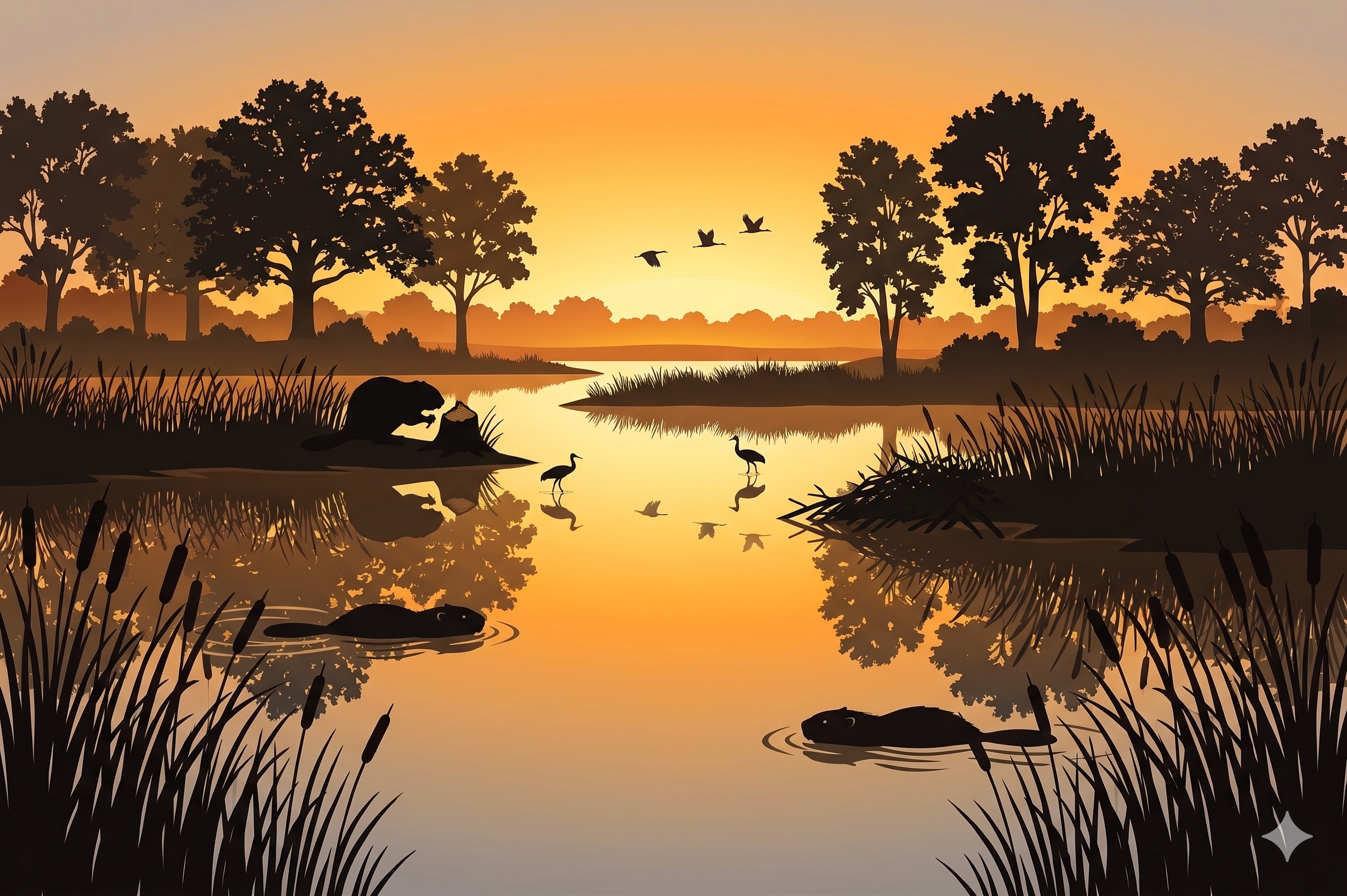
The Ioway people, whose name for their homeland is often translated as "beautiful land," knew something the rest of us are still learning.
I came to Iowa as the child of Polish immigrants, and I fell in love with it the way you fall in love with a place that asks nothing of you except attention. The sunrises over the cornfields are genuinely stunning. The sunsets — fiery orange bleeding into magenta over a flat horizon — stop you mid-sentence. I played in the creeks and the woods as a kid, swam in the ponds, canoed down rivers on long slow afternoons with nothing to do but watch herons and let my thoughts wander. Iowa felt, to me, like a place where the wild was still in charge.
It took me years to understand that this was almost entirely an illusion.
Iowa is, by most ecological measures, the most altered landscape in the United States. Not the most urbanized — the most altered. More than 90% of its land is under cultivation. Since European settlement, the state has lost 99% of its original tallgrass prairie — one of the most biodiverse ecosystems on the continent, now functionally extinct. It has lost 95% of its wetlands. The beaver, once a keystone species that built and maintained those wetland systems across the entire watershed, was effectively eliminated alongside them. What looks from a car window like a green and generous landscape is, ecologically speaking, closer to a factory floor — extraordinarily productive, meticulously managed, and almost entirely stripped of the natural systems that made it viable in the first place.

This is the hidden history underneath Iowa's beauty. And it is directly relevant to what the state — and its neighbor Illinois — are about to build next.
A report out of Korea this week put a number on something I've been watching build for years. Even without factoring in climate change, Korea already faces a meaningful water deficit. Add realistic climate projections, and that shortfall multiplies roughly eightfold. The government called it alarming. They are right. But the more instructive thing is not the number itself — it is the fact that Korea both created this problem and is now among the most capable countries on earth at addressing it. That arc is worth following carefully, because the Upper Midwest is at the beginning of the same story.
For two centuries, industrial America targeted wetlands systematically. Not out of malice — out of logic that made complete sense at the time. Low-lying land near rivers and harbors was cheap, flat, and close to water transport. The cultural and legal consensus treated it as wasteland. The Corn Belt states — Iowa and Illinois at the center of that story — have lost more than 85% of their historic wetlands since European settlement. That loss happened one drainage ditch, one industrial park, one straightened river channel at a time, mostly along the same Mississippi riparian corridor that now anchors some of the most consequential infrastructure investment in the country's history.
What we were dismantling was the surface water system's working infrastructure. One acre of wetland, one foot deep, holds up to 1.5 million gallons of water. It recharges groundwater, moderates flood cycles, filters agricultural runoff, and returns precipitation to the water table rather than sending it straight to the Gulf. No engineered system replicates this at scale or at comparable cost. When you drain it, you are pulling the pipes out of the wall before the replacement plumbing exists.
Now the industries that need that water most are arriving in force — and they are arriving in Iowa and Illinois specifically.
We talk constantly about securing neon gas, rare earth elements, and extreme ultraviolet lithography machines as the critical inputs for the advanced tech supply chain. We almost never talk about the millions of gallons of ultra-pure water required to keep those fabs running. A large semiconductor fabrication facility can consume 10 million gallons per day, and producing that ultra-pure water demands roughly 1.5 gallons of input for every usable gallon. Water is not a background utility in advanced manufacturing. It is a critical industrial raw material — and a localized water deficit is a tech supply chain bottleneck, not an environmental abstraction.
Data centers are a different story, and an important one to get right. A hyperscale facility runs at one to five million gallons per day — real but modest compared to a fab, and a rounding error next to the 80% of US freshwater that agriculture consumes. The data center industry has moved faster on water efficiency than most sectors, investing in closed-loop cooling, reclaimed water sourcing, and water-positive commitments. Google's Cedar Rapids campus integrates water-free cooling into significant portions of its operation. If you want to demonstrate that new industrial infrastructure can be built with a net zero water mandate, data centers are the right starting point — the operators have capital, public scrutiny, and the technology to do it. What they need is a policy framework that makes the obligation binding and ties it to the land where they are building.
Google has committed over $10 billion to Iowa data center infrastructure. Microsoft is building hyperscale capacity in West Des Moines. QTS has a $1.75 billion facility under construction near Cedar Rapids. Illinois lifted its decades-long moratorium on new large nuclear reactors in January, opening the path for advanced reactor siting. And NextEra and Google have signed an agreement to restart the Duane Arnold nuclear plant in Iowa — bringing carbon-free baseload power back to the grid to feed exactly the AI infrastructure now clustering around it.
This is the corridor. This is the moment. And this is where Korea becomes not a cautionary tale, but an active partner.
Hanwha, one of Korea's largest conglomerates, is already embedded in the American clean energy build-out through Qcells — the only company in North America producing a fully integrated solar supply chain from ingot to finished panel, with community solar projects operating in Illinois and supply agreements powering Midwest installations at scale. That is not a peripheral presence. It is a $2.5 billion commitment to American energy infrastructure made by a Korean company that understood, before most Western firms did, that the energy transition required manufacturing investment on domestic soil. Hanwha's presence in this corridor is a foundation to build on, not a footnote.
But the deeper Korean asset here is water knowledge. Korea built world-class water management expertise out of structural necessity — a climate that concentrates rainfall into a short monsoon window, topography that loses most of it before it can be captured, an industrial base that demands water at scale. K-water, the national water resources agency, has spent decades developing smart watershed monitoring, AI-driven flood forecasting, and constructed wetland treatment systems now being deployed across water-stressed markets in Asia and beyond. That body of practical, deployable knowledge maps directly onto the restoration engineering challenge the Mississippi riparian corridor presents. Korea has already solved problems that Iowa and Illinois are just beginning to price.
There is also a nuclear-water connection that trade discussions are not framing correctly yet. Korea's nuclear export pipeline carries next-generation reactor designs with integrated water management capacity. The technology Iowa and Illinois are now permitting is technology Korea has been building and refining for a generation. The partnership logic is obvious. The institutional conversation has not caught up.
So here is the proposal — and it is not theoretical.
Iowa and Illinois should condition a meaningful portion of the economic development incentives attached to new data center and nuclear construction on a binding Net Zero Water obligation: specifically, the restoration of 200,000 acres of riparian wetland along the Upper Mississippi corridor over the next decade. For every gallon of new industrial water demand these facilities create, a quantifiable offset must be established through wetland restoration that demonstrably returns equivalent water retention capacity to the regional hydrological system.
The legal infrastructure for this already exists. The NRCS Wetland Reserve Easement program has operated in Iowa since 1993 with over 1,500 enrolled easements. The Upper Mississippi River Restoration initiative has already improved or created over 110,000 acres of habitat. The science is settled, the methodology is proven, the corridor is mapped. What is missing is the forcing mechanism that connects industrial water demand to restoration supply within the same accounting framework — the same conceptual move carbon accounting made three decades ago when it gave corporations something legible to be held to.
A Korean partner — whether Hanwha through its Midwest energy presence, K-water through its water management expertise, or the Korean nuclear industry through its emerging US project partnerships — is a natural co-architect of this framework. Korea has navigated this problem at national scale. It has the monitoring technology, the wetland design experience, and the hard-won institutional knowledge of what it costs to rebuild water security after you have lost the natural version of it.
Net Zero Carbon finally has the scaffolding it needs because someone built it. Net Zero Water needs the same — a clear concept, a measurable target, and a first mover willing to make the ask. The Upper Mississippi corridor, with Korean partnership and the political will of two states that understand what they are building on, is the right place to start.
Here is the part of Iowa's history that almost nobody outside the state knows. By 1912, Iowa's landowners had spent more money on agricultural tile drainage than the United States government spent to build the Panama Canal. The Canal cost roughly $400 million. Iowa drainage cost more. Across the state today, an estimated 800,000 miles of subsurface tile pipe runs beneath the fields — a hidden infrastructure system larger than the interstate highway network, installed over decades to pull water out of the land and send it downstream as fast as possible. It worked. Iowa became one of the most productive agricultural regions on earth. It also became one of the most dewatered.
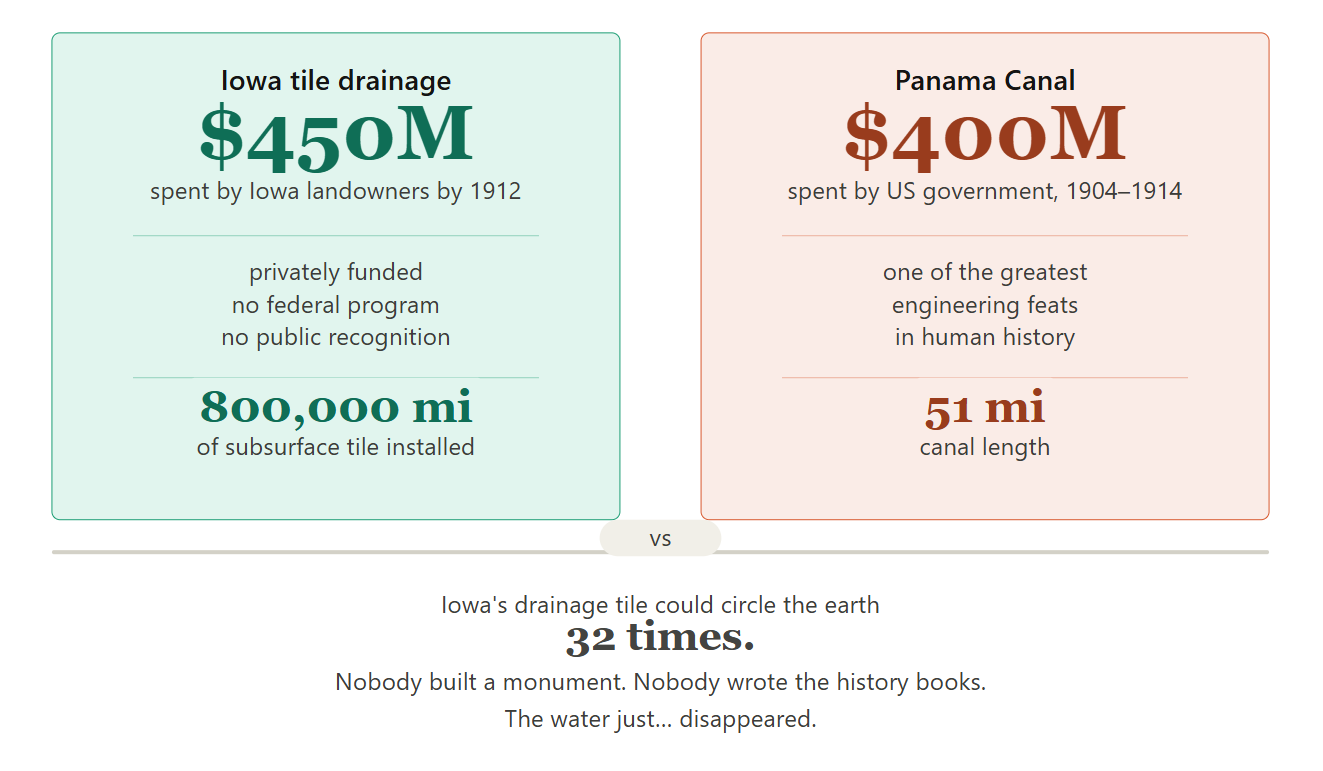
I came to Iowa as an immigrant, the child of Polish parents who found in it the same thing a lot of people find — open land, honest work, and a community that takes the long view. I love this state. Which is exactly why I think it deserves to be the place where the country figures out how to put the water back. Not out of guilt for what the tile did, but because the same capacity for large-scale, coordinated, unglamorous infrastructure investment that built 800,000 miles of drainage pipe can build 200,000 acres of restored wetland. Iowa knows how to do hard things quietly. This would be one more.
The generation building data centers and reactors along the Mississippi has a chance to do something the tile-laying generation could not have imagined: restore the water system while building the infrastructure that depends on it. With Korean partnership, the technical framework exists. With Iowa and Illinois political will, the corridor is available. The only thing left is to make restoration part of the deal — the same way drainage was once part of the deal for anyone who wanted to farm this ground.